A calculator that turned product-matching emails into a tool engineers reach for every day
KUVER GmbH, a Berlin manufacturer of flexible high-current connections, had a problem common to many technical B2B companies: customers didn't know which product matched their requirements. We built an online calculator - and it became one of the most frequently used tools among electricians and installation designers across Europe.
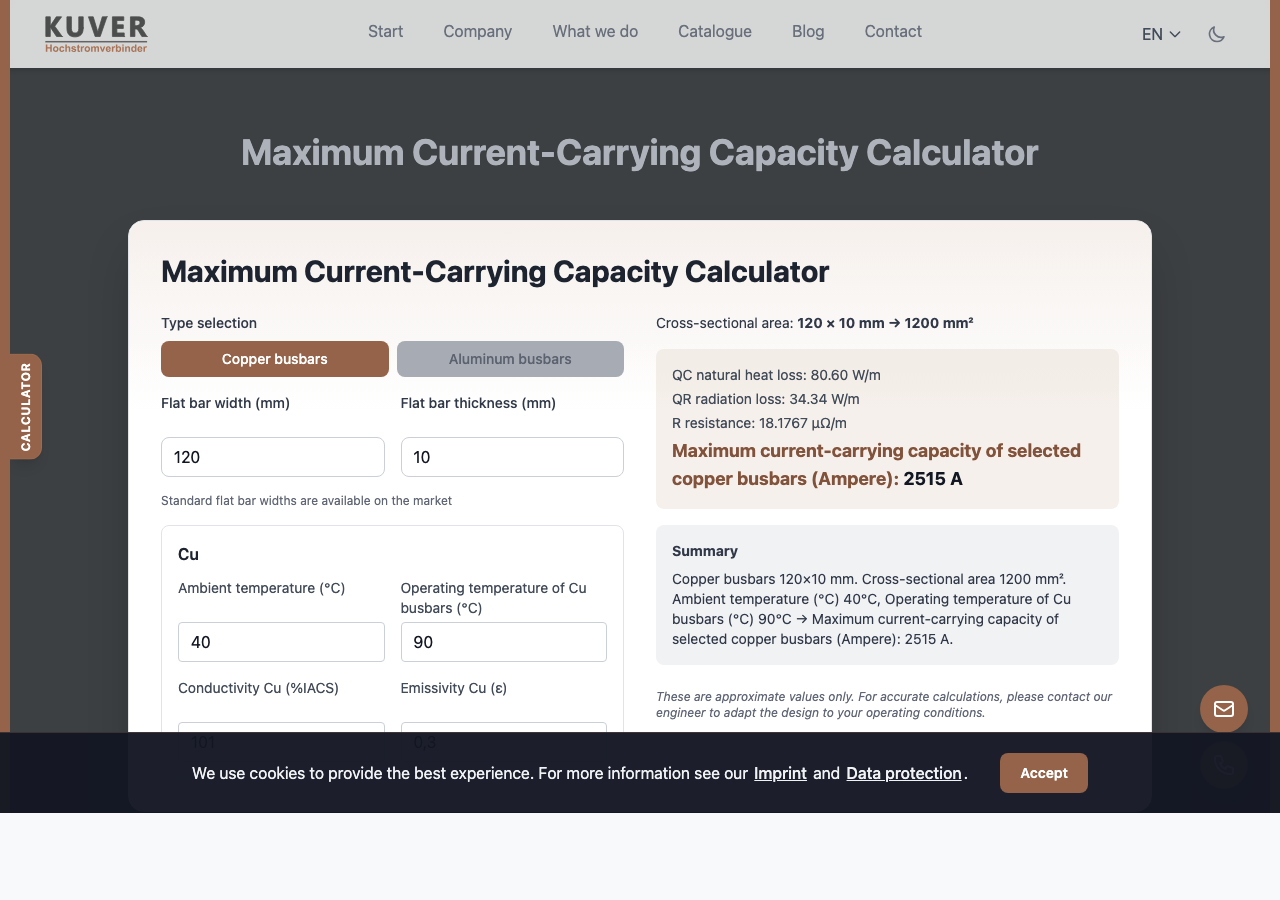
The problem: specialists needed a fast answer to a specific technical question - can a busbar of given dimensions safely carry the required current under particular thermal conditions? Without an online tool, every enquiry landed in someone's inbox and required a manual response. We built a calculator that answers in under a second - and in doing so created a daily-use tool that brings professionals back to the KUVER website again and again.
The client: a specialist manufacturer with a deep catalogue
KUVER GmbH is a Berlin-based company specialising in flexible high-current connections - copper and aluminium busbars, braided tapes, compensation connectors, and flexible conductors. Their products reach electricians, switchgear designers, and industrial plants across Europe.
The catalogue spans more than a dozen product lines with hundreds of dimensional variants. This is typical for technical B2B: the manufacturer has deep product knowledge, but the customer has to figure out which variant meets their requirements - or ask a sales engineer.
The problem: every enquiry is a separate consultation
The core question every customer asks: will a 40x5 mm copper busbar handle 300 A at an ambient temperature of 35°C and a working temperature of 80°C? This can be calculated from physical formulas - factoring in material conductivity, natural convection, thermal radiation, cross-section, and length.
Before the calculator, the company had three options:
- A specialist answers emails - effective, but time-consuming. At scale, it absorbs engineering time that could be replaced by actual orders.
- The customer calculates it themselves - possible, but it requires access to formulas and material parameters that most practising electricians don't have to hand.
- The customer guesses and orders on spec - the cost of being wrong: time, a return, a delayed project.
Each option had its own cost - either on the company's side or the customer's. And a customer who has to wait two days for a reply often checks the competition in the meantime.
The solution: the calculator as a gateway to the product
We designed and built an interactive maximum current-carrying capacity calculator - embedded directly in KUVER's product pages, no login required, no call-to-action to contact sales.
The user inputs:
- Busbar material - copper or aluminium
- Cross-section dimensions: width and thickness in millimetres
- Ambient temperature (°C)
- Maximum working temperature of the conductor (°C)
- Electrical conductivity of the material (% IACS) and surface emissivity (epsilon)
And instantly receives:
- Cross-sectional area of the busbar (mm²)
- Natural convection heat loss (QC, W/m)
- Radiation heat loss (QR, W/m)
- Linear resistance of the busbar (R, µOhm/m)
- Maximum permissible current (A) - the bottom-line result
The calculator doesn't replace the specialist - it complements them. It gives a professional the answer to a question they ask themselves multiple times a day, without needing to pull out a formula sheet or wait for an email.
Why this works commercially
A technical tool on a B2B company's website isn't a gimmick. It's a bridge between a need and a product. The mechanics are straightforward:
- The professional searches for an answer - they type "busbar current calculator" into Google, or arrive via a recommendation from a colleague.
- They get an accurate result - precise, consistent with KUVER's material parameters, with no registration required.
- They associate the brand with the tool - next time, they start their search at the KUVER website, not a search engine.
- They already know which product they need - they have the dimensions, they have confirmation it meets the spec. The path to ordering is short.
Regular calculator users become regular customers. Not because the company pushes them, but because the tool removes the last barrier before purchase: uncertainty about product selection.
The effect you don't plan for, but that drives engagement
The tool took on a life of its own. Electricians share the calculator link on industry forums, in professional groups, and in company intranets. Installation designers bookmark it as a standard step in the design workflow. This is a kind of marketing that can't be bought with an advertising budget - it happens naturally because the tool is genuinely useful.
For KUVER, this means a steady stream of users who arrive not through an ad but through a specific technical need. And that need is already half-answered the moment they land on the page.
Technology: simple, because the goal is clear
The calculator requires no backend or database - all calculations run client-side in the browser. This means:
- Instant response - the result updates immediately as any input parameter changes
- Zero server infrastructure - no cost of maintaining a calculation server
- Offline operation - the calculator works without a constant internet connection, important for professionals working in the field or in industrial facilities with limited connectivity
- Full responsiveness - usable on a desktop in a design office and on a phone beside a distribution board
The implementation uses precise physical formulas for heat transfer - a natural convection model for horizontal and vertical busbars, and a Stefan-Boltzmann radiation model - so results align with industry standards and real-world conditions, not just rough estimates.
What this means for other B2B companies
The KUVER case illustrates a pattern that repeats across many companies selling technical or specialist products:
- The customer has a specific technical need but isn't certain which product meets it
- Verification requires knowledge or time the customer doesn't have
- The company that removes that barrier shortens the path to purchase and establishes itself as the expert
A calculator, a configurator, a product matcher - these aren't marketing tools. They're sales tools that work around the clock, with no cost-per-click and no sales engineer required for every enquiry.
The best lead generation is the kind where the customer qualifies themselves - they calculate, check, compare, and then return with a ready specification. A calculator does exactly that.
FAQ
Does an online calculator genuinely increase B2B sales?
Yes, if it removes a real decision-making barrier. A tool that helps a specialist make a technical choice builds brand trust and shortens the path to purchase. The customer returns already knowing which product they need. - See other C3S deployments
How much does building an interactive product calculator cost?
A simple calculator with defined formulas and result display starts from a few thousand euros. A version with integrations - PDF generation, multiple languages, order form or CRM connection - from ten thousand upwards. Quoted after a free consultation. - See pricing models
How long does it take to deploy a technical calculator?
A calculator with predefined formulas and a responsive interface typically takes two to four weeks from brief to deployment. Adding multi-language support, PDF generation, or order-system integration extends the project by one to three weeks. - MVP in 6 weeks
Does the calculator have to be part of the company website?
Not necessarily. Embedding it in an existing site gives better SEO and visual consistency. A standalone app makes sense when the calculator is more complex - with login, calculation history, or document generation. We choose the architecture to match the goal. - Let's talk
Turn your product-matching emails into a tool that sells itself.
Free consultation and a quote within 48 hours - no commitment, with clear budget ranges.