Technology
How we refreshed consaldi.pl - a professional look, and a site that does not slow down
The consaldi.pl website refresh: how we combined a professional, rich look with real speed and strong PageSpeed results, and why we optimized it for AI engines (LLMs).
We refreshed the website of our sister studio consaldi.pl, and from day one we had one firm rule: a professional, rich look must not come at the cost of speed. Too many company websites look 'serious' but take several seconds to open - and both the user and the search ranking suffer for it. This article shows what we focused on, what results we achieved, and why we put just as much weight on visibility in AI engines.
If you are thinking about refreshing your own site, treat this as a concrete list of things that genuinely make a difference.
The starting point: why refresh a website at all
consaldi.pl is an advisory site - diagnosing processes and technology for companies. A site like this has to build trust in the first few seconds. The refresh was therefore not a 'change of colours' but the delivery of three goals at once:
- the look, which communicates professionalism and order,
- the speed, because a slow site kills the impression of professionalism before anyone reads the offer,
- the visibility - both in classic Google and in answers generated by AI.
The last one is new and many redesigns skip it. I will come back to it below.
A heavy look, light code
The most important thing we want to convey here: a visually 'heavy' design does not have to mean a heavy website. These are two different things that are easy to confuse.
A premium impression comes from proportion, typography, whitespace and refined detail - not from megabytes. Page weight, on the other hand, is usually driven up by three things: unoptimized images, piles of JavaScript from ready-made templates, and a slow server. While refreshing consaldi.pl we watched exactly these three fronts:
- Images cropped to their real dimensions and served in modern formats, with lazy-loading of anything below the first screen.
- Code without excess ballast - no heavy frameworks 'just in case', minimal scripts, styles loaded once.
- A fast server and transport: the site runs over HTTP/2, with compression, and we keep time to first byte (TTFB) well below the threshold of perception.
The effect is measurable. The server responds in around 120 milliseconds, content travels compressed (gzip) and secured with an HSTS header, and the HTML document itself is a few kilobytes of transfer. This is the foundation that makes a good PageSpeed score possible at all - because even the best-optimized graphics will not help if the server thinks for a second.
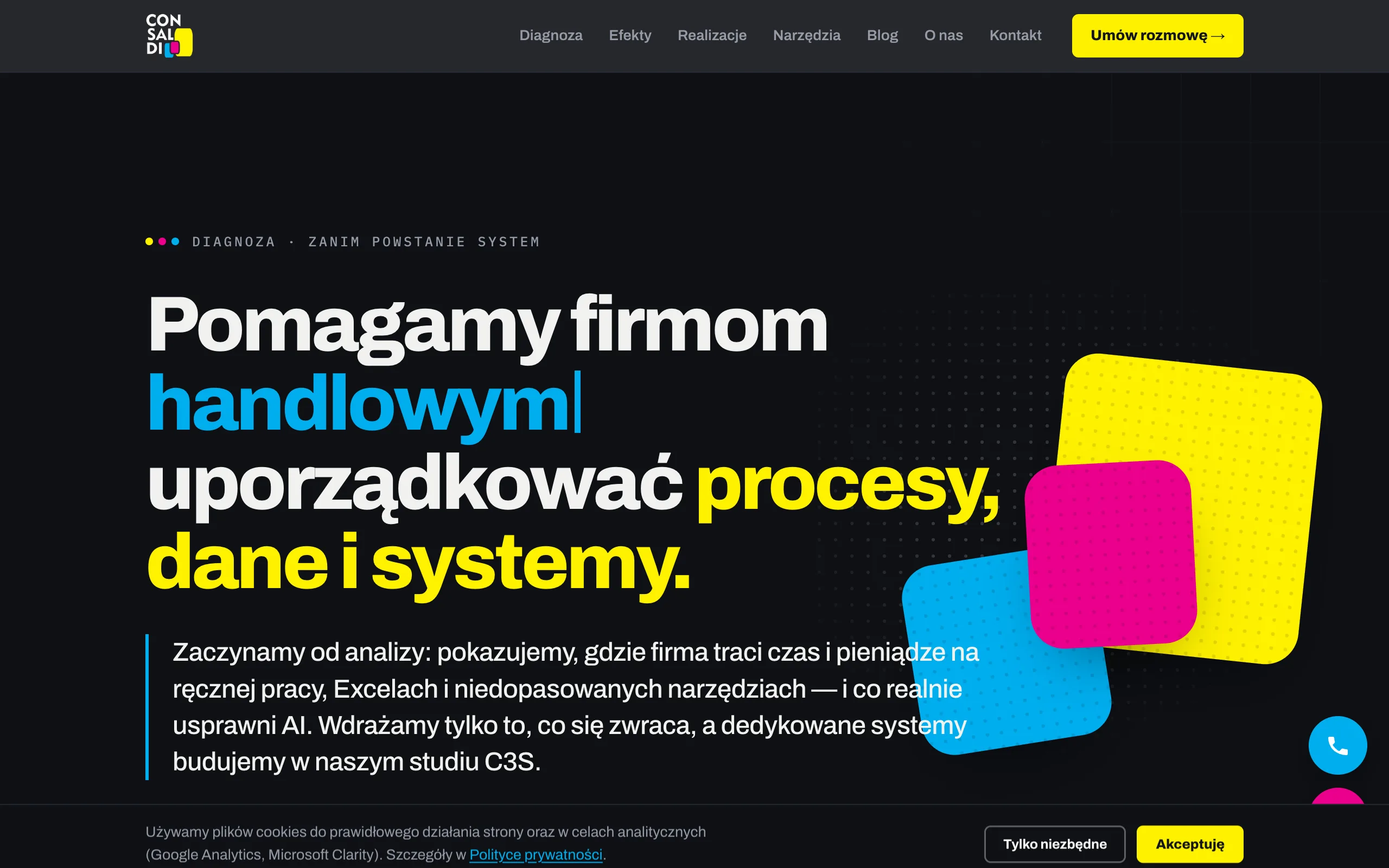
PageSpeed results
Speed is not declared - it is measured. The reference point is Google PageSpeed Insights, which rates a site in four categories (Performance, Accessibility, Best Practices, SEO) and shows Core Web Vitals: LCP, INP and CLS. We always test mobile and desktop separately, because it is on the phone that sites most often fall apart.
The desktop result speaks for itself:
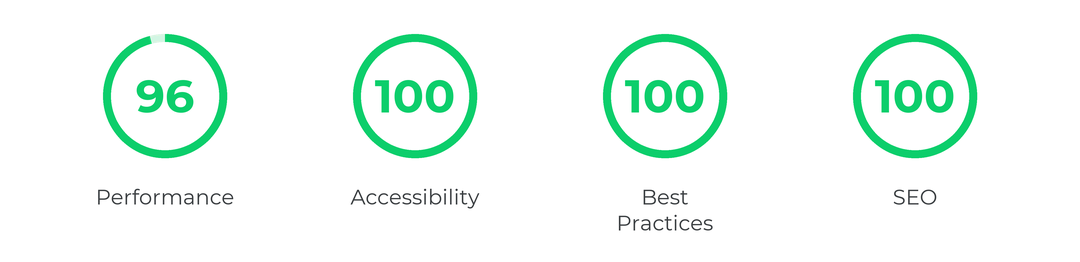
96/100 for performance and a perfect 100/100 for accessibility, best practices and SEO, with an LCP of 0.9 seconds, zero Total Blocking Time and virtually no layout shift (CLS). For a site with such a rich, dark design and strong typography, that is a very good result.
On mobile it is just as interesting:
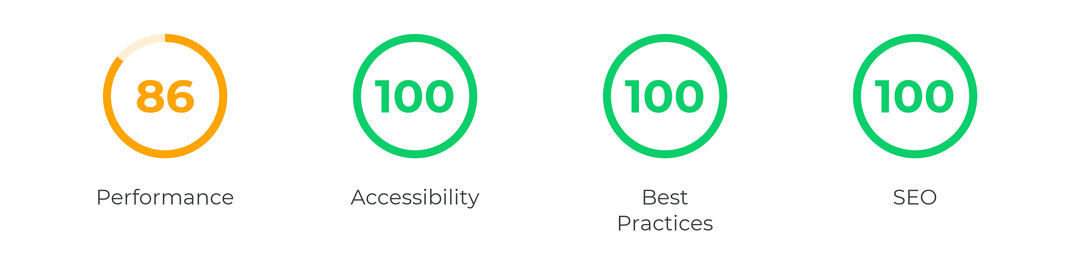
Here too 100/100 for accessibility, best practices and SEO, with performance at 86/100 - solid, even though the phone is always a harder exam (slower connection, weaker processor). Total Blocking Time and CLS are exemplary (0 ms, 0), and the only real area left to optimize is LCP - and we know exactly what drives it. That is the value of measuring: we do not guess, we see the specific lever.
For the record, the hard technical parameters (measurable independently of Lighthouse):
- TTFB (time to first byte): approx. 120 ms
- Protocol: HTTP/2
- Compression: gzip, with a secure HSTS header
- Document weight: a few kilobytes of transfer (compressed HTML)
These are the numbers a user feels as 'the site opens instantly' - and which Google rewards in ranking.
Focus on LLMs: so that AI 'sees' the site too
More and more often a client does not reach a site through ten blue links, but through a ready AI answer - in ChatGPT, Perplexity or Google AI Overviews. If a model cannot read and cite your site, you simply are not in that answer. That is why the consaldi.pl refresh also covered LLM optimization (GEO - Generative Engine Optimization).
What exactly we paid attention to:
- Structured data (schema.org). The site describes itself in machine-readable JSON-LD - who the company is (`WebSite`), what services it provides (`Service`, `OfferCatalog`, `Offer`) and where it operates (`PostalAddress`). This lets AI engines unambiguously understand what consaldi.pl is.
- An `llms.txt` file. A kind of content map for language models - a concise index of what is on the site and what it is about. It helps AI reach the point without wading through the whole site.
- Clean, semantic HTML. Content lives in the code, not glued on solely by scripts - so both Google bots and AI crawlers can see it.
- Self-contained paragraphs. The text answers specific questions directly, so a model can lift a ready fragment as a quote.
The result of this work shows up in AI-readiness tests. In the agentic browsing category, consaldi.pl scored a perfect 3/3. In practice this means an AI agent - one that visits a site on its own, reads it and extracts information on the user's behalf - gets full, unblocked access to the content and data. This matters more and more: AI assistants increasingly visit sites 'live' instead of relying solely on previously indexed text. If a site blocks bots, hides content behind scripts or loads too slowly, the agent simply gives up on it - and picks the competitor it was able to read.
This is exactly the approach we use at C3S for the blog and custom-built websites - content written to be citable by AI, backed by structured data and fast, accessible code.
What you can take from this when refreshing your own site
If you are planning a redesign, here is the short version of what to push for - in this order:
- Start by measuring. Run a PageSpeed Insights test (mobile and desktop) on your current site. Without a baseline you do not know what you are improving.
- Separate 'look' from 'weight'. You can have a rich, premium design and a light site at the same time - it is a matter of images, code and server, not the visual effect.
- Deal with the images. They are usually the biggest eater of seconds: correct dimensions, WebP/AVIF, lazy-loading.
- Cut unnecessary JavaScript. Every extra library and widget is a cost. Keep only what genuinely works.
- Check the server. HTTP/2, compression, a sensible TTFB and caching are free speed out of the gate.
- Think about AI, not just Google. Structured data, `llms.txt` and citable content now decide whether you appear in answers generated by models.
- Do not forget to submit the changes at the end. After publishing, update `sitemap.xml` and `llms.txt`, and submit the new and changed URLs to Google Search Console and Bing Webmaster Tools (the IndexNow protocol). That last one has a double meaning today: AI engines rely on Bing's index, so a quick IndexNow notification genuinely shortens the time before your content can appear in model answers. Even the best optimization is useless if search engines and LLMs do not know that something has changed.
Summary
The consaldi.pl refresh confirmed something we keep telling clients: a professional look and speed are not an either-or choice. A rich, orderly design can be combined with instant loading and good PageSpeed results - and, along the way, the site can be prepared so that AI engines see it too.
Want to refresh your website so it looks serious, loads instantly and is ready for the age of AI search? Get in touch - we will start with an audit and tell you straight whether optimization is enough or a rebuild is worth it.
FAQ
Does a rich, elaborate design have to mean a slow website?
No. The feeling of heaviness comes mostly from unoptimized images and too much script, not from a rich look itself. With well-sized images (WebP/AVIF), lean code and no unnecessary libraries, a site can look polished and load instantly at the same time.
Where should I start when refreshing my own website?
Start by measuring the baseline in PageSpeed Insights and defining the business goal of the site. Only then do you know what to actually fix: usually it is image weight, server response time (TTFB) and excess JavaScript.
What does optimizing a website for LLMs mean?
It means preparing content and data so that AI engines (ChatGPT, Perplexity, Gemini) can easily read and cite them: clean HTML, structured data (schema.org), self-contained paragraphs that answer questions directly, and an llms.txt file acting as a content map for the models.
What PageSpeed scores are considered good?
In practice, aim for 90-100 in each of the four categories (Performance, Accessibility, Best Practices, SEO), with Core Web Vitals in the green: LCP under 2.5 s, INP under 200 ms, CLS under 0.1.
How long does a website refresh take and how much does it cost?
It depends on scope - from a few days for performance and content fixes to a few weeks for a full redesign. The starting point is always an audit: it shows whether optimization is enough or a rebuild is warranted.